Miriam's Story
“The surgeon told me that my cancer was recurrent and incurable, but it can be treated. He said it was a bit like playing Whack-a-Mole.”
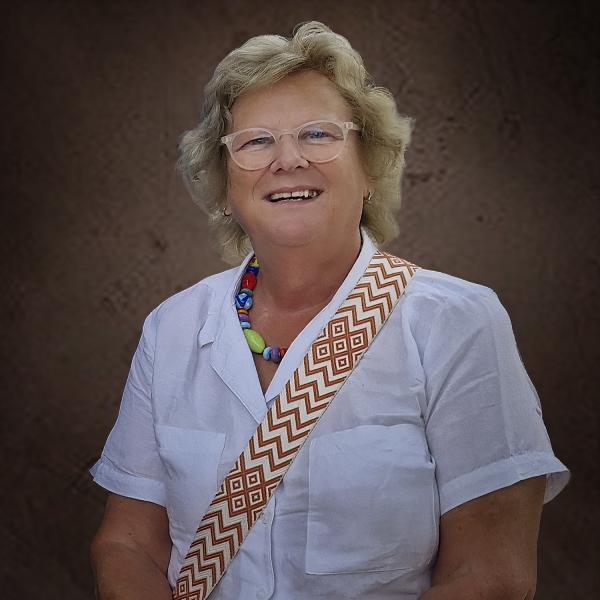
Leading up to Christmas 2017, Miriam Hilliard, 68, who lives in Louth and is originally from Kerry, noticed some unexplained bleeding. It presented as occasional spotting, though it would sometimes be heavier. She was initially unconcerned but decided to mention it to her GP in February 2018. The GP immediately sent a hospital referral, and in March 2018, Miriam went to the Mater Hospital for her appointment with an oncology consultant.
“I didn’t tell anybody, not even my husband, about the referral,” says Miriam, who is a mother of two. “I went to see the consultant, and he sent me for a dilation and curettage (D&C) about a week later. I told my family I was going for a routine procedure, and I could be collected later that day. My son dropped me off at the Mater on his way to work with no worries. In hindsight, that was a big mistake.
“I didn’t want to tell anyone in my family about it, until I knew what it was. I felt that there was no point in worrying them unless it turned out to be cancer. If it was cancer, our lives would change, and I didn’t want to put the worry I had about the tests onto other people just in case it was nothing, although by now I suspected it could be cancer.
“The day before I went to hospital for the D&C, I was walking on the beach in Skerries with my husband and I remember thinking, ‘If I tell him about these tests, our world could fall apart’, so I foolishly said nothing.”
After the D&C, Miriam was kept in overnight as she had a strong reaction to the aesthetic and they wanted to observe her while it wore off. Miriam’s consultant called her husband, Barry, to tell him that anomalies had been found in the D&C.
“It came as a complete surprise and shock to him and my two sons,” says Miriam. “They had no opportunity to think every scenario through for themselves. and when they got the news by phone, they were all in total shock.
“I didn’t tell any of my family, because I thought it would be a good idea – I could keep the worry away from them, but it actually caused more worry.”
Miriam’s diagnosis was stage two endometrial cancer. When she received the news, her response was a pragmatic one.
“I never thought, ‘Why me?’. I always felt that I wasn’t going to sit in a corner with a shawl around me. I never saw it as a life-threatening thing, just something I needed to deal with.”
In April 2018, Miriam underwent a radical hysterectomy followed by chemotherapy. All was going well until, 15 months later, a routine scan showed that she had endometrial cancer in three of her lymph nodes. She had radiotherapy, brachytherapy and chemotherapy.
“17 months after that, I got it in my lung and thought, ‘Now, this is trouble’,” says Miriam. “But it was still endometrial cancer, it had just popped up in my lung. I remember the surgeon said, ‘I’ll take that off, no problem’. It was a straightforward operation; I had it on the 6th of December 2022 and attended my son’s wedding on the 22nd of December. I had chemo afterwards.”
A little over a year later, Miriam had to contend with another endometrial cancer reoccurrence. This time, it was in the lining of her stomach.
“I had to have another operation,” says Miriam. “The surgeon had to cut the ligaments in my stomach. As a result, I had to wear a binder for six months, and I had chemotherapy following the operation.”
Miriam’s medical team discovered that her endometrial cancer was oestrogen receptive, so she was put on an oestrogen blocker. Since she’s been on that medication, she hasn’t had a reoccurrence.
“I got scans every three months since my first diagnosis in 2018, but this recently switched to every four months because things are going well."
Miriam’s experience of her medical team was very positive. She says that every stage of treatment and each diagnosis was explained, and her treatments options were discussed in a manner she could easily understand.
Reflecting on her cancer experience, Miriam says that accessing Irish Cancer Society-funded counselling in the Gary Kelly Cancer Support Centre in Drogheda helped her to understand what she had been through and the decisions she made.
“I thought I won’t tell anyone about what was happening at the beginning because I didn’t want them to be upset. But in counselling, I realised I was taking on responsibility for everyone’s emotions, but that’s not something I can be responsible for. It gave me a lot of clarity.”
Having retired from her job in education, Miriam now volunteers with the Irish Cancer Society and Cancer Trials Ireland. She wants to highlight what signs people should look for when it comes to endometrial cancer, and to share the reality of it.
“Treatment for endometrial cancer can affect your sexual function,” says Miriam. “I think it is not talked about enough. Many women may not be aware of the impact, which can be very debilitating.
“I think intimacy is a really important part of living well after cancer, and the effect of gynaecological cancer treatment on sexual functioning isn’t spoken about enough.”
Miriam’s cancer occurred four times in six years and she is now cancer free for the last two-and-a-half years. Miriam advises anyone who notices changes in their body to go to their GP and to be proactive about their health.
“Go to your GP if you notice anything. The sooner, the better. And be open to your loved ones. as they will be a great support. If you think something isn’t right, you’re better off getting it checked out than waiting. It’s so important to be proactive about your health.”
As for her advice for anyone who has recently been diagnosed with cancer, Miriam says: “Any fears you have, you should discuss them with your medical team. I’d also recommend going to a Daffodil Centre or your local cancer support centre. Talking to other people is really helpful because they’re in the same boat as you and they understand. You can make fantastic friendships along the way.”