Surgery for vulval cancer

Information about surgery for vulval cancer and its side-effects.

Types of surgery

The aim of surgery is to remove the cancer. The type of surgery depends on the size and position of the cancer. There are different types of surgery, such as:

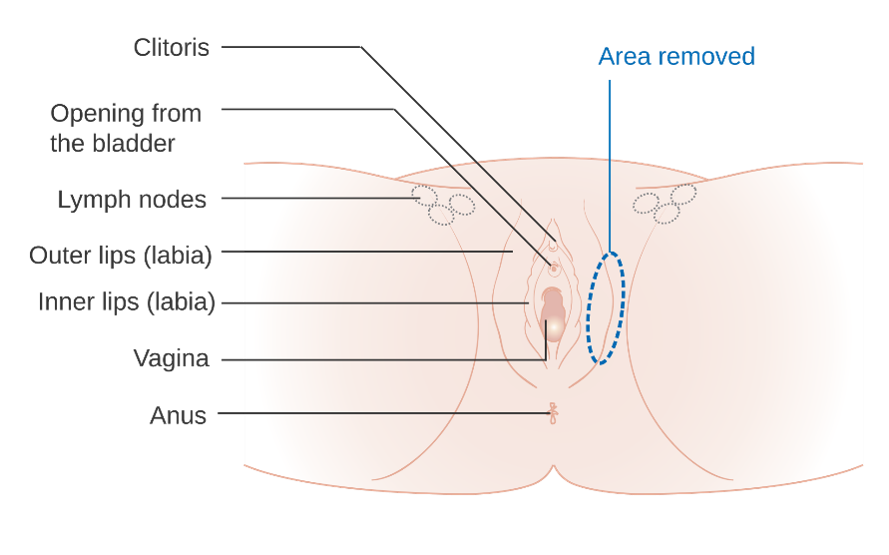
  • Wide local excision: In this surgery, the cancer cells are removed as well as a border area of healthy tissue around it. This might also be done if you have vulval intraepithelial neoplasia (VIN) to prevent it from turning into an invasive cancer.
Diagram showing vulva and area marked for surgery by wide local excision. The area is marked with a blue dotted line and is an oval shape comprising most of the centre of the outer lip (labia) on the right of the diagram.
  • Radical local excision: In this surgery, the cancer and a larger border area around it are removed. The surgery may include removing the lymph nodes as well. This is called a lymphadenectomy.
  • Partial vulvectomy: In this surgery, part of the vulva is removed.
  • Total or radical vulvectomy: In this surgery, the entire vulva and the surrounding lymph glands are removed, including the lips of the vagina and possibly the clitoris.
  • Pelvic exenteration: If the cancer has spread beyond the vulva, the affected organs may be removed. For example, the cervix or part of the lower bowel or bladder.
Sentinel node biopsy

Your doctor might do a sentinel node biopsy to find out more about whether your cancer has spread. The sentinel node is the first lymph node that fluid from the vulva drains into. If the sentinel node has cancer cells in it, it’s possible that the cancer has spread to nearby lymph nodes.

Doctors check the sentinel node before removing other lymph nodes. This is because removing all the lymph nodes from your groin can affect the drainage of fluid and can cause lymphoedema (swelling). Read more about lymphoedema here.

Vulval reconstruction

If you have had surgery to remove part or all of your vulva, you might be able to have reconstruction surgery. Vulval reconstruction is where a new vulva is created using skin and muscle from other areas of your body. Your surgeon can tell you if it’s possible to have a reconstruction.

Side-effects of vulval cancer surgery

With all surgeries there is a small risk of bleeding and infection.

Signs of infection include:

  • High temperature
  • Generally feeling unwell
  • Feeling hot or cold
  • Shivering
  • Feeling sick
  • Decreased appetite
  • An ooze or a strong smell from the wound
  • Your wound looks red and feels hot
  • Foul-smelling or cloudy urine
  • Cough

Let your medical team know right away if you have any signs of infection or if you notice your wound is bleeding. Read more about the signs of infection here.

Bladder side-effects

You may have a tube (catheter) inserted to drain your bladder for a week or more after surgery. After the tube is removed, your bladder may still be slow to empty for a while, and may need to be emptied with a catheter occasionally. 

Bowel side-effects

You may get constipated, as your bowels may be slow after surgery. You may need to take a laxative for a few months. Your doctor will prescribe these if needed.

Early menopause

If your ovaries are removed during surgery, you will go into early menopause. Symptoms of menopause can include hot flushes, dry skin, dryness of your vagina, reduced sexual desire, night sweats, mood swings, poor concentration and osteoporosis. 

Read more about managing menopausal symptoms.

Risk of blood clots

Surgery in your pelvis puts you at risk of clotting in the deep veins of your legs and body (called DVT). You may be given injections to prevent this for a month after surgery. You or a member of your family will be invited to learn how to give the injection. It is very easy. 

Getting up and about and exercising your legs is most important in preventing DVT.

Lymphoedema

Lymphoedema is when lymph fluid builds up and causes a part of your body to swell up. With vulval cancer it is usually the legs that are affected. Lymphoedema is usually caused if surgery or radiotherapy to the lymph nodes stops the lymphatic system from working as well as it should. 

It can develop months or years after treatment has ended. The risk of getting lymphoedema is highest for the first 1 to 3 years after treatment. Look out for the signs and symptoms: if it is found early, it is easier to manage. Read more about lymphoedema.

Other complications

Very rarely, serious complications happen after radical surgeries like hysterectomy or pelvic exenteration. These can include leakage from the bladder or bowel, or narrowing of the tubes that bring urine from the kidneys to the bladder. You may need more surgery to help with these problems.


Sexual problems

Surgery can create scar tissue that can cause narrowing and shortening of your vagina. This can make sex uncomfortable. There are ways to help with this, such as dilation, which means using a dilator or vibrator to stretch the vagina. 

Vaginal surgery can also lead to vaginal dryness, which can make sex uncomfortable. If your clitoris is removed, it will affect your ability to have an orgasm. 

There are treatments and supports to help you if you’re having sexual problems. Read more about sexual side-effects of cancer treatments and get advice to help you cope. 

Having surgery to your vulva can affect you emotionally, and this can also affect your relationships or your sex life. If you find you are finding it difficult to cope, reach out to your medical team. They’ll be able to advise and refer you for further support.

You can also read more about sexual relationships and cancer here.

Sex after vaginal reconstruction

Sex can feel different after surgery to your vulva. This may put you off having sex. It’s common to feel frightened or scared at first, but taking things slow and practising different positions with your partner can help you to enjoy sex again. Your consultant or liaison nurse can help to put you in touch with a sexual counsellor if you feel you need extra support.

You can also read more about sexual relationships and cancer here.

If you want to talk to a Cancer Nurse in confidence, call 1800 200 700, go to a Daffodil Centre or email the nurses at supportline@irishcancer.ie 

Fertility

If you have a hysterectomy, you will no longer be able to have children. Read more about fertility and cancer treatment and where to get support.

Body image

Some people may feel self-conscious about how their genital area looks after treatment. If you are struggling, please to reach out to your GP, Clinical Nurse Specialist (CNS) or medical team for support. It can help to talk about how you feel. 

Read more about coping with body image issues and cancer.

Emotional effects

You might feel shocked or upset at the thought of surgery to your vulva. Surgery can have an impact on your emotions. If you find you are finding it difficult to cope, reach out to your medical team. They’ll be able to advise and refer you for further support.

Or contact our Cancer Nurses in confidence: call 1800 200 700, go to a Daffodil Centre or email the nurses at supportline@irishcancer.ie 

You can also read more about coping with the effects of cancer here. 


Talk to a Cancer Nurse

Support Line

Support Line

Support Line
Our Cancer Nurses offer confidential advice, support and information for anyone affected by cancer. Call or email supportline@irishcancer.ie. Video calls available. Mon-Fri: 9am-5pm
Our Daffodil Centres

Our Daffodil Centres

Our Daffodil Centres
Our Daffodil Centres in 13 hospitals nationwide are staffed by Cancer Nurses and trained volunteers who provide face-to-face advice, support and information for anyone affected by cancer.