Elaine's story
“It’s important that people get their eyes tested. And it’s really important to get that OCT (Optical Coherence Tomography) scan that is offered because that scan saved my life.”
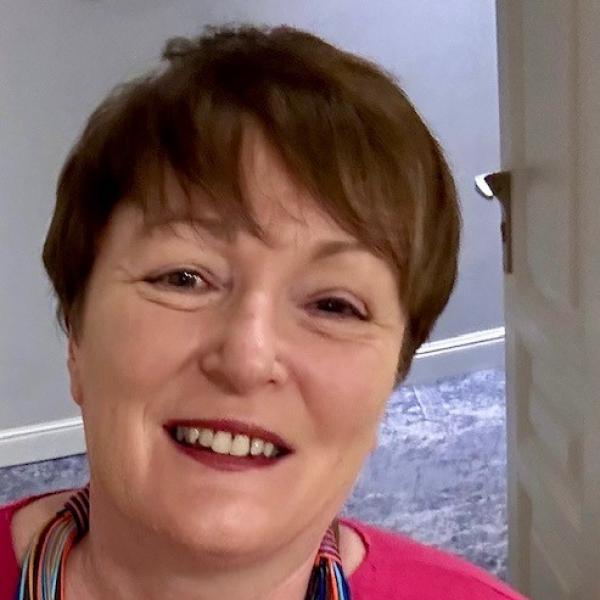
Elaine O’Callaghan, from Cork, had never heard of eye cancer or ocular melanoma before she went in for a routine eye examination in 2018.
During her examination at an optician in Portlaoise, her optician asked if she had any other symptoms. Elaine had previously noticed a ‘flicking’ or ‘flashes’ in the side of her eye, in addition to some headaches that she would have otherwise not considered symptoms, and mentioned this. Her optician then conducted an OCT scan which consists of dilating the eye and gives images of the layers at the back of the eye and retina. She was referred for more tests to be conducted in Waterford the following day.
“It should’ve sounded alarm bells to be asked to go to the hospital asap, but I never panicked, as what could be seriously wrong with my eye?"
She went to Whitfield Clinic in Waterford the next day. “They went straight in, and they started doing all these tests, including blood tests and an MRI. It was very hectic that morning.”
The ophthalmologist conducting the tests told Elaine that she had a detached retina, which could have been caused from a fall or a bang in the head. Although in her case, there was something else there. The doctor told her they would order her for an MRI scan, as the worst-case scenario would be a tumour.
Elaine rang her sister Olivia, who is a nurse, because she wasn’t sure the gravity of what the result of the MRI scan might be. Oliva drove down from Cork to Waterford, and they were told on a Friday afternoon that Elaine had ocular melanoma, eye cancer. As it was before the weekend, there wasn’t a concrete plan put in place for Elaine as she needed to be referred to the only consultant that dealt with this diagnosis in the Royal Victoria Eye and Ear in Dublin.
“When you’re told that, it’s an awful experience and something you’ll never forget,” Elaine says. “Your mind goes into overdrive, so you don’t even think of ringing someone, like the Irish Cancer Society, to talk to. It was extremely lonely."
“I was left in total limbo. When you do look up Google, it’s horrendous what you read.”
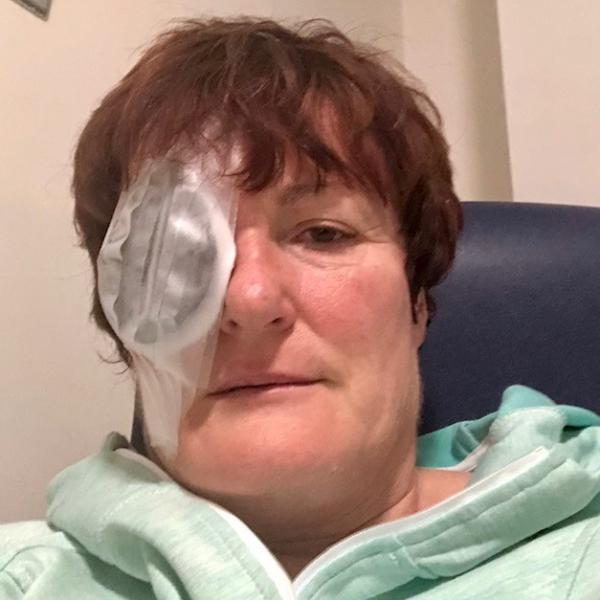
Elaine was officially diagnosed in September 2018 when she was 48 and referred for treatment by Dr. Horgan in the Eye and Ear Clinic in Dublin. She had the option to complete her treatment in Liverpool or wait another month due to a revamp for the theatres in the St. Luke's Hospital Dublin. She decided to have the treatment in Ireland, beginning in October, because she needed her friends, work colleagues and family around her to support her.
Her treatment didn’t require chemotherapy. Instead, she would have brachytherapy – with radioactive seeds stitched onto the tumour to deliver a high dosage of radiation for ten days.
While undergoing her treatment, Elaine was in the company of three other patients, who also had ocular melanoma. The group called themselves ‘Patches’, for the eye patches they wore. The four of them were radioactive for the ten days at the time of treatment, so developed a close and unique bond with each other.
“When I tried to explain to people the friendship we have, I can’t, because the four of us helped each other, in many ways by just being there and totally understanding each other.”
“Somebody might have a question - oh, what do you feel? Do you think this feeling is okay? What should I do? There was so much help that we were able to give to each other by just supporting each other.”
If ocular melanoma spreads, it can often spread to the liver. If that happens, then the patient’s survival outcomes can vary, and with medical advancements the lifespan has being prolonged for this deadly disease. In Elaine’s Patches group, two of the four women’s cancer spread to their liver, and have since passed away.
“You live with the feeling of not knowing if this disease will spread, but to see two of your friends succumb to this disease is heartbreaking. Rest In Peace to both ladies, they will never be forgotten by us.”
Elaine had started treatment in October, then went back to work in February the following year.
“I wanted normality. When I did get back to work, a counsellor said, ‘the person who left that day is not the same as the person who returned’. And they were right. Everything overwhelmed me.”
It was only when Elaine returned to work that she got connected with the Irish Cancer Society, when her interest in a return-to-work policy signposted her to the organisation.
Since completing her treatment, Elaine has volunteered with the Irish Cancer Society and met other volunteers. She helped to start a Colleague resource Cancer support group in her work and is also a member of the Butterfly Community, a support group across the whole of her company, which she is an ambassador in Ireland for. She continues to volunteer with the Irish Cancer Society, supporting her colleagues in their return to work.
Elaine has also become a mentor with Imerman Angels through her involvement with the Butterfly community in Pfizer, which uniquely matches individuals who have navigated similar cancer journeys—regardless of where they are in the world. This opportunity allows Elaine to offer support and guidance to others facing similar challenges, building connections across borders and making a real difference.
“My diagnosis has opened amazing avenues for me. This journey has led me to things I would have never gotten involved in and has steered me into helping others and working with the Irish Cancer Society,” she says.
Elaine now has yearly scans on her eye and liver to check the tumour that is still in her eye is dormant and that her liver is clear of any cancer. “You still have that ‘scanxiety’, it never leaves you; you just learn to cope with it. You have good days and bad days.”
She adds that she sought counselling, which helped. Elaine didn’t like that many people would say to her ‘I know what you’re going through’. She says: “I kept saying back: you don’t know what I’m going through because you don’t have cancer."
“I even struggled saying that word, ‘cancer’, I kept saying ‘the tumour’. To this day I more often say I had ocular melanoma other than cancer.”
If she could give advice to someone who has been diagnosed with eye cancer, it would be: “Reach out to people, because the more you talk to somebody who’s going through this diagnosis, it answers those questions that you might otherwise go to Dr. Google for, which aren’t right. The Peer Support service that the Irish Cancer Society provides is a valuable resource for new patients, and the service has recently recruited an ocular melanoma patient as a volunteer. I have also found great comfort and support in the Ocular Melanoma Ireland Facebook group, which is in an online community of patients and carers with lived experience of this type of cancer and offer a great support and a community within Ireland."
“There are huge advancements in a treatment named Kimmtrack and other treatments which treats specific eye cancers. There are brilliant people working on this. It’s not the doom and gloom story it would’ve been in 2018 when I heard those dreaded words.”
Eight years after her diagnosis, Elaine has little to no vision in her right eye. “I’ll take the loss of sight for the loss of my life,” she says.