Thyroid cancer
Thyroid cancer affects about 280 people in Ireland each year. It is more common in women and in people over 40.*

Signs and symptoms
Learn about the signs and symptoms of thyroid cancer. You are more likely to survive cancer if you find it at an earlier stage.

Treatments
There are a number of different treatments available for thyroid cancer. Your medical team will explain the best treatment options for you.
What is thyroid cancer?
The thyroid is a small gland at the front of your neck. It makes important hormones that are released into the bloodstream. Every cell in your body depends on these hormones to function normally.
Thyroid cancer happens when cells in your thyroid change and start to grow in an abnormal way. A group of these cancer cells can form a tumour. Caught early, most thyroid cancers are curable.
What are the types of thyroid cancer?
The most common type of thyroid cancer is called differentiated thyroid cancer (DTC).
There are two main types of DTC:
- Papillary thyroid cancer is the most common type of thyroid cancer accounting for about 4 out of 5 thyroid cancers diagnoses. It is more common in women aged 35 to 45. It is generally slow growing and has a high cure rate.
- Follicular thyroid cancer accounts for about 1 in 5 thyroid cancer diagnoses. It grows slowly and is usually found in older people.
Rarer types of thyroid cancer
Medullary thyroid cancer is a very rare type of thyroid cancer that often runs in families. It can be linked to faulty genes like RET. The cancer develops in the C cells of the thyroid, which make the hormone calcitonin. Calcitonin helps to regulate the amount of calcium in your blood.
Read more about cancer and genetics.
Anaplastic thyroid cancer is a very rare cancer. It is most often found in older people. This type of cancer grows quickly and can be difficult to treat.
Papillary and follicular cancers have a lot of features in common so they are collectively known as differentiated thyroid cancers (DTCs).
What is the thyroid?
Your thyroid is a small gland at the front of your neck that is shaped like a butterfly. It sits at the base of your throat, on top of your windpipe (trachea) and below your voicebox (larynx). The gland has 2 halves called lobes.
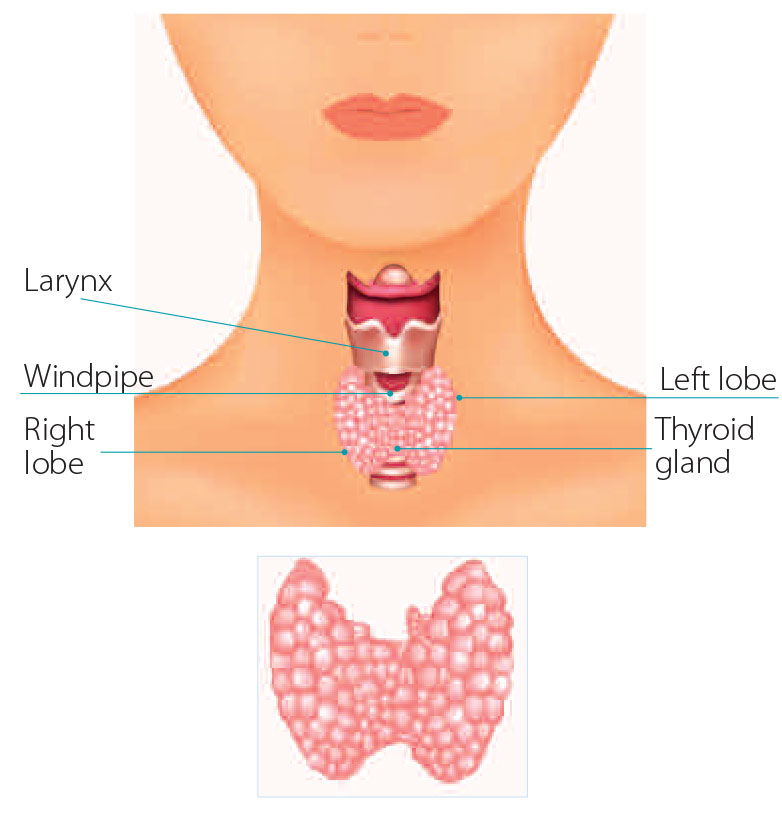
The thyroid is part of a network of glands that make up your endocrine system. The endocrine system makes hormones that help to control various functions in your body.
What do thyroid hormones do?
Every cell in your body depends on the hormones made by your thyroid in order to work normally.
The thyroid gland releases 3 separate hormones:
- T3, which is known as triiodothyronine
- T4, which is known as thyroxine
- Calcitonin
T3 and T4 affect your heart rate, blood pressure, body temperature, the speed at which food is changed into energy (metabolism) and your weight.
Calcitonin helps control the levels of calcium in your blood. Calcium is a mineral that has many important jobs, such as building and maintaining strong bones.
What increases my risk of thyroid cancer?
The cause of thyroid cancer is unknown. But there are certain things called risk factors that can increase your chance of developing the disease. These include:
Most cases occur in people over 40.
Women are more at risk than men.
These are not cancer but include an enlarged thyroid (goitre), thyroid nodules (adenomas) or an inflamed thyroid (thyroiditis).
If you have very little iodine in your diet, you are at risk.
If you have been exposed to radiation from a nuclear plant, you can develop thyroid cancer many years later.
If you had radiotherapy as a child, you may be more at risk in later life of developing thyroid cancer.
You are more at risk if a family member has had medullary thyroid cancer.
You may be at risk if you inherit faulty genes. For example, the RET gene may cause medullary thyroid cancer. Also, the bowel condition called familial adenomatous polyposis (FAP) may lead to thyroid cancer.
An overactive or underactive thyroid does not increase your risk of developing thyroid cancer.
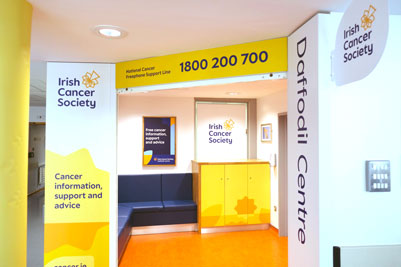
Having a risk factor doesn’t mean you will get cancer. Sometimes people with no risk factors get the disease. If you’re worried, talk to your GP or talk to one of our cancer nurses. Call our Support Line on 1800 200 700 or visit a Daffodil Centre.
Reducing your risk of thyroid cancer
The most important thing you can do to reduce your risk of thyroid cancer is to:
- Get checked with your GP if you have a family history of medullary thyroid cancer.
Medical content updated from our 'Understanding thyroid cancer' booklet (2026), reviewed by Prof Marie Louise Healy, Consultant Endocrinologist; Cristina Domsa, Endocrinology Clinical Nurse Specialist; Naomi McElroy, Senior Medical Physicist; Una Murphy, Daffodil Centre Nurse.
Talk to a Cancer Nurse

Support Line


Our Daffodil Centres
*The Irish Cancer Society uses the most up-to-date cancer statistics from the National Cancer Registry Ireland, available on www.ncri.ie