Surgery for oesophageal cancer
Information about the types of surgery used to treat oesophageal cancer, including oesophagectomy, oesophago-gastrectomy, total oesophagectomy and lymphadenectomy.
Surgery is the most common treatment for cancer that hasn’t spread outside the oesophagus. You’ll have tests before surgery to make sure you are well enough.
Read more about getting ready for surgery.
Types of surgery
Your surgeon may remove the whole oesophagus or just the part that has cancer. It depends where the cancer is.
Because the oesophagus is a long tube going from one body part to another, the surgery can be done in different ways. Your surgeon may need to make a cut (incision) or cuts in your chest, tummy (abdomen) or neck to remove the tumour, depending on where it is.
Common types of surgery:
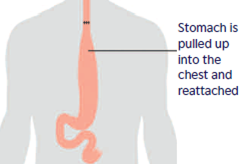
The part of your oesophagus with cancer is removed, along with lymph nodes and nearby soft tissues. The surgeon pulls up your stomach and joins it to the remaining part of your oesophagus.
Rarely it’s not possible to join your stomach to the remaining part of the oesophagus. In this case, a section of your bowel (colon) will be used to replace part of the oesophagus.

Images courtesy of Cancer Research UK / Wikimedia Commons
If the cancer has spread to your stomach, the upper part of your stomach can be removed, as well as the affected part of your oesophagus. This is called an oesophago-gastrectomy. The intestine or colon may be used to create a new connection so that you can
swallow and digest food after your oesophagus is removed.
If more of the stomach is involved than the oesophagus, sometimes the whole stomach is removed and the remaining oesophagus is joined to the small bowel (called an extended total gastrectomy).
This is an operation to remove the uppermost part of the oesophagus and the voicebox (larynx) to treat cancers found very high up in the oesophagus and in the pharynx (throat).
During the surgery your surgeon will take out some of the lymph nodes from around your oesophagus. This is called a lymphadenectomy. If the lymph nodes contain cancer, removing them can help to stop it spreading and may help guide further treatment. The removed lymph nodes will be looked at under a microscope to give your doctor more information about the stage of your cancer. stage of your cancer.
After oesophageal surgery
- For a few days you will be in the intensive-care or high-dependency unit.
- You may be fed through a tube in your small intestine until you can eat normally again. You may go home wih the tube, if necessary,
- Having an operation for oesophageal cancer is major surgery, however most people can go home after 10-14 days.
- You will feel very tired at times and will need plenty of rest. You may feel weak and lacking in energy for at least 3 months or up to a year afterwards.
- For at least 3 months, avoid strenuous activity like vacuum cleaning or lifting heavy bags of shopping. Also avoid bending over from the waist. If you need to pick up something from the floor or tie your shoes, bend from the knees and crouch down.
- You will not be able to drive for 6–8 weeks after surgery. Your doctor and nurse will discuss this with you.
Read more about recovering after surgery.
Eating-related issues after surgery
It may take a while before you get back to normal eating and drinking. It depends on the type of surgery you have and the time it takes for your wounds to heal.
You might experience:
- Feeling full and uncomfortable after eating only small amounts
- Having little or no appetite
- Weight loss
- Nausea and vomiting
- A change in your bowel habit e.g. diarrhoea or constipation
Weight loss is normal after this surgery. It often improves over time, though you may not return to your previous weight. Your care team will support you with eating, symptoms, and weight management.
Heartburn/reflux
These symptoms are common after oesophageal cancer surgery, as valves that keep acid inside your stomach are opened up at the time of surgery. This means that when you have a full stomach tube you are more likely to feel reflux (such as after meals) and you may also have reflux when you lie flat or bend over.
It can help to sleep in a more upright position, by using pillows or a wedge under the mattress.
People who have had an oesophagectomy should take a regular antacid medication (proton pump inhibitor) to prevent acid reflux, even if they are not experiencing reflux symptoms.
People who have had their stomach removed may benefit from
other medications to help manage heartburn symptoms related to bile refluxing – you can discuss this with your team at your follow-up appointments.
Dumping syndrome
Dumping syndrome can happen after oesophageal cancer surgery. It happens when food, particularly high-sugar or high-fat food, travels too quickly into the small intestine. It can cause various symptoms. Slowing down the movement of food from your stomach to the intestine can help to avoid dumping syndrome.
Early dumping syndrome usually happens 30 to 60 minutes after a meal. It causes symptoms such as tummy pain, bloating, stomach rumbling, nausea and diarrhoea. It can also cause fatigue, flushing, sweating and heart palpitations.
Late dumping syndrome usually happens 1 to 3 hours after a meal. It can make you feel very tired, weak, confused, hungry, irritable or faint. It can also cause sweating and palpitations.
For most people, dumping syndrome settles after a while.
Let your doctor, nurse or dietitian know if dumping syndrome
continues to be a problem. They will be able to give you more
advice.
Dumping syndrome - Tips to help
- Avoid too much fluid at mealtimes - fluid with meals can cause food to travel into the small intestine faster. If possible, avoid drinking liquids 30 minutes before and after meals.
- Eat slowly, chewing foods well.
- Don’t skip meals. Eat small and frequent meals throughout the day.
- Eat high-protein foods. These are foods like meat, fish, cheese, eggs, beans and lentils. Adding protein to meals slows down the absorption of sugar into the bloodstream.
- Choose higher fibre, slow-release carbohydrates. For example, oats, basmati or brown rice, wholemeal or granary breads, lentils, beans, chia or flax seeds, wholegrain pasta and potatoes with skins on. Limit white bread, pasta and shortgrain rice.
- Cut down on sugary foods like sweets, chocolate and sugary drinks.
- Rest for 15-30 minutes after a meal.
More information
There's more information on recovering from surgery in our oesophageal cancer booklet. Download the booklet below, order a copy from our Support Line on 1800 200 700 or pick one up in a Daffodil Centre.
Talk to a Cancer Nurse

Support Line


Our Daffodil Centres