Anal cancer
Anal cancer affects about 80* people in Ireland each year. Anal cancer can be treated with chemoradiation, chemotherapy, radiotherapy or surgery.

Signs and symptoms
Learn about the signs and symptoms of anal cancer. You are more likely to survive cancer if you find it at an earlier stage.

Treatments
There are a number of different treatments available for anal cancer. Your medical team will explain the best treatment options for you.
What is anal cancer?
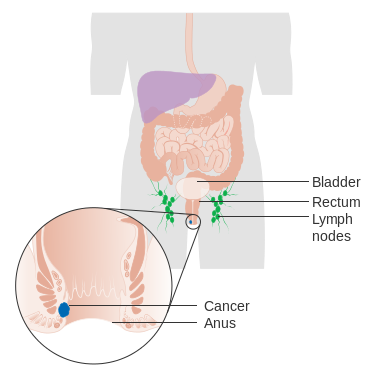
Anal cancer affects the anus. The anus is the opening below the rectum where waste food passes out of your body as stools (poo).
As the cancer grows it forms a collection of cells (tumour). This tumour can cause a blockage and cause symptoms. It is a rare cancer: about 80 people are diagnosed with anal cancer in Ireland every year.*
Anal cancer is different from bowel cancer (also known as colon or rectal cancer). If you're not sure what the difference is or how it affects you, you can call our Support Line on Freephone 1800 200 700.
What is the anus and what does it do?
Your anus or anal canal is found at the end of your large bowel, which opens to the outside of your body. When you pass a bowel motion (poo), it passes through your anus.
Your anus is controlled by a ring of muscle called the sphincter. This opens and closes to allow poo to pass from your body.
(Image courtesy of CRUK / Wikimedia commons)
What increases my risk of anal cancer?
These risk factors can increase your chance of getting anal cancer:
HPV is a viral infection that is passed from person to person during sexual contact. Your risk of getting the virus increases if you have many sexual partners. Most people are exposed to HPV and usually it clears up on its own and doesn’t cause any problems.
Read more about HPV.
Men and women who have anal sex are more at risk of developing anal cancer. This may also be due to the presence of the HPV virus.
Cigarette smoking can also increase your risk of anal cancer. It can delay a HPV infection from clearing up.
If you are taking medication to reduce your immunity, you have a higher risk of developing anal cancer. For example, after an organ transplant.
If you are infected with the human immunodeficiency virus (HIV), your risk of developing anal cancer is higher because your immune system may not work as well to clear an HPV infection.
Having a risk factor doesn’t mean you will definitely get cancer. Sometimes people with no risk factors get the disease.
Reducing your risk of anal cancer
- Stop smoking.
- Have the HPV vaccine injection if you are under the age of 26.
Medical content updated from our 'Understanding bowel (colorectal) and anal cancer' booklet (2025), reviewed by:
Prof Michael E. Kelly, Chair of Surgery -Trinity College Dublin/St James Hospital, Dublin
Prof Charles Gillham, Consultant Radiation Oncologist
Dr Emily Harrold, Consultant Medical Oncologist
Delia Flannery, Colorectal Nurse Specialist
Emma Loughnane, Oncology Clinical Nurse Specialist
Barbara Parkinson, Daffodil Centre Nurse

Talk to a Cancer Nurse

Support Line


Our Daffodil Centres
*The Irish Cancer Society uses the most up-to-date cancer statistics from the National Cancer Registry Ireland, available on www.ncri.ie